
FOR RESEARCH USE ONLY. The content provided in this article is for educational and informational purposes only and is based on published scientific literature. The compounds and delivery formats discussed are not approved by the FDA for human or veterinary use. They are strictly intended for laboratory research and in vitro experimentation. Restore Peptides does not endorse or encourage the use of these products outside of a controlled research setting.
Selecting the appropriate solvent for peptide research in a laboratory setting is not a trivial decision. The choice between bacteriostatic water and sterile water for injection directly affects analyte stability, assay reproducibility, and the usable window for prepared solutions in the laboratory. For researchers reconstituting lyophilized synthetic peptides, understanding the chemical and functional differences between these two solvent types is a foundational aspect of good laboratory practice.
Despite their similar appearance – both are clear, colorless, and sterile – bacteriostatic water and sterile water differ in composition, shelf life after opening, compatibility with analytical instrumentation, and suitability for different experimental protocols. Choosing the wrong solvent for a given application can introduce confounding variables, accelerate compound degradation, or compromise the integrity of downstream assays.
This article provides a detailed comparison of bacteriostatic water and sterile water from an analytical chemistry perspective, covering their chemical composition, USP specifications, stability profiles, and practical considerations for peptide reconstitution in research laboratories.
Key Takeaways
- Bacteriostatic water contains 0.9% benzyl alcohol as an antimicrobial preservative, while sterile water for injection contains no additives
- The benzyl alcohol in bacteriostatic water inhibits microbial growth for up to 28 days after initial vial puncture, making it suitable for multi-access laboratory use
- Sterile water offers lower total organic carbon (TOC) and eliminates preservative-related interference in sensitive analytical assays
- Solvent selection should be guided by the specific analytical method, the sensitivity of the assay, and whether the prepared solution will be accessed multiple times
- Both solvent types must meet United States Pharmacopeia (USP) standards for purity, sterility, and endotoxin levels
What Is Bacteriostatic Water?
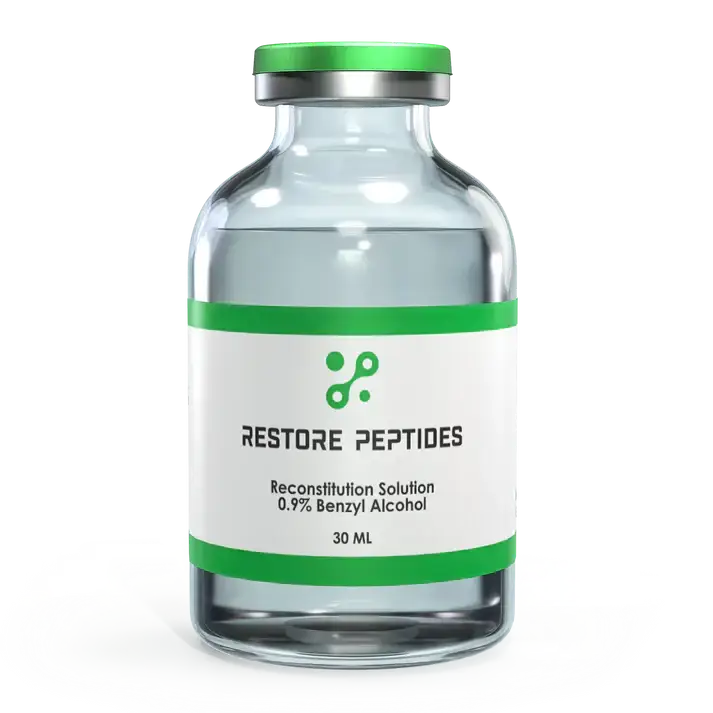
Bacteriostatic water is United States Pharmacopeia (USP) grade sterile water that contains 0.9% (v/v) benzyl alcohol as an antimicrobial preservative. The term “bacteriostatic” refers specifically to the mechanism of action – the benzyl alcohol concentration is sufficient to inhibit bacterial reproduction without necessarily killing all microorganisms outright. This is achieved through disruption of microbial cell membranes and interference with metabolic processes at the 0.9% concentration threshold (Meyer et al., 2007).
The resulting solution has a pH of approximately 5.7, which is slightly acidic relative to pure water. This pH profile and the presence of benzyl alcohol are the two primary factors that distinguish bacteriostatic water from other laboratory-grade water types.
Because the preservative suppresses microbial contamination following initial vial puncture, bacteriostatic water is classified as a multi-access solvent – meaning it can be accessed multiple times over a defined period (typically 28 days) while maintaining sterility and microbial safety standards. This characteristic makes it a practical choice for research laboratories that prepare solutions in multiple aliquots from a single vial over time.
What Is Sterile Water for Injection?
Sterile water for injection (SWFI) is USP-grade purified water that has undergone sterilization processing and contains no preservatives, antimicrobial agents, or other additives. It is chemically pure H₂O with a neutral pH, minimal total organic carbon, and verified absence of bacterial endotoxins.
Without a preservative, sterile water does not inhibit microbial growth once the sealed container is compromised. It is therefore designated as a single-use solvent – once the vial is opened, any remaining volume should be discarded to prevent contamination. This single-use requirement is an important operational consideration for laboratories managing multiple experiments with prepared peptide solutions.
Sterile water’s chemical simplicity is its principal advantage in analytical applications. The absence of any additive means it introduces no additional organic compounds, no pH modification, and no potential interference with detection methods or biological activity assays.
Bacteriostatic Water vs. Sterile Water for Peptide Reconstitution – Key Differences
Understanding the distinction between bacteriostatic water and sterile water requires examining several dimensions beyond simple composition. Researchers working within the research use only framework should be familiar with how solvent selection affects downstream analytical outcomes.
Preservative Content and Microbial Control
The defining difference is the presence or absence of benzyl alcohol. At 0.9% concentration, benzyl alcohol provides sustained antimicrobial activity that prevents bacterial proliferation in the solution for approximately 28 days post-puncture (Nema & Ludwig, 2019). Sterile water provides no such protection – once exposed to a non-sterile environment, microbial contamination can begin immediately.
For research applications requiring repeated access to a reconstituted solution over days or weeks, bacteriostatic water’s preservative function reduces the risk of microbial contamination that could degrade the analyte or invalidate experimental results. For single-use preparations where the entire volume is consumed immediately, sterile water eliminates the preservative variable entirely.
pH and Buffering Characteristics
Bacteriostatic water’s pH of approximately 5.7 differs from the near-neutral pH of sterile water (approximately 7.0). This difference can be significant for pH-sensitive peptide sequences. Some synthetic peptides exhibit different stability profiles, solubility characteristics, or conformational behavior depending on the pH of the reconstitution solvent. Researchers should consider whether the slightly acidic environment of bacteriostatic water is compatible with their specific analyte before selecting a solvent.
Analytical Interference Considerations
Benzyl alcohol absorbs UV light and contributes to total organic carbon measurements. For researchers using UV spectrophotometry, HPLC with UV detection, or TOC-sensitive analytical methods, the presence of benzyl alcohol introduces a background signal that must be accounted for in calibration and data interpretation. Sterile water, containing no organic additives, produces a cleaner baseline for these analytical techniques.
In mass spectrometry applications, benzyl alcohol presents as an additional ion that appears in the spectrum. While this is manageable with appropriate method development, it adds complexity to spectral interpretation – particularly when working with low-concentration analytes where the preservative signal may approach or exceed the analyte signal.
Solution Stability and Usable Duration
Solutions prepared with bacteriostatic water can typically be stored and reaccessed for up to 28 days under appropriate refrigeration (2-8°C), assuming aseptic technique is maintained during each access. This extended usability window is advantageous for research protocols that require periodic sampling from the same prepared solution.
Solutions prepared with sterile water should be used within a single session or, if aliquoted under aseptic conditions, consumed within a shorter window – generally 24-72 hours under refrigeration – due to the absence of preservative protection against microbial growth.
USP Standards and Quality Specifications
Both bacteriostatic water and sterile water for injection are manufactured to United States Pharmacopeia (USP) standards that define requirements for purity, sterility, particulate matter, endotoxin levels, and packaging integrity. These standards align with the same quality benchmarks used by leading peptide suppliers in the United States to verify compound integrity.
USP specifications for sterile water for injection (USP <1231>) require verified sterility, endotoxin levels below 0.25 EU/mL, total organic carbon below 500 ppb, and conductivity within defined limits. Bacteriostatic water must meet these same baseline requirements plus additional specifications for the benzyl alcohol preservative content (0.9% ± accepted tolerance) and demonstrated antimicrobial effectiveness.
For research procurement purposes, sourcing USP-grade solvents from reputable suppliers with documented quality management systems ensures that the water used in peptide reconstitution meets the purity thresholds required for reliable analytical work. Certificate of Analysis (COA) documentation should accompany each lot, confirming sterility testing, endotoxin assay results, and preservative concentration (for bacteriostatic water).
Solvent Selection Guidelines for Peptide Research Laboratories
Choosing between bacteriostatic water and sterile water for a given research application depends on several practical and analytical factors. Rather than a one-size-fits-all answer, the decision should be guided by the specific requirements of the experiment.
Bacteriostatic water is generally appropriate when:
- The prepared solution will be accessed multiple times over a period of days to weeks
- The analytical method is not sensitive to benzyl alcohol interference
- The research protocol requires working aliquots maintained at refrigeration temperature between uses
- The slightly acidic pH (5.7) is compatible with the analyte’s stability profile
Sterile water is generally appropriate when:
- The entire prepared volume will be consumed in a single experimental session
- The analytical method requires minimal organic background (UV spectrophotometry, sensitive HPLC, TOC analysis)
- The analyte is sensitive to benzyl alcohol or requires neutral pH
- The experiment demands the most chemically inert solvent possible
In practice, many research laboratories maintain both solvent types and select based on the requirements of each individual experiment.
Proper Storage and Handling of Laboratory-Grade Water
Regardless of which solvent type is selected, proper storage and handling are critical to maintaining the quality required for reproducible research results.
Unopened vials of both bacteriostatic water and sterile water should be stored at controlled room temperature (20-25°C) in their original sealed packaging, protected from light and temperature extremes. Once opened, bacteriostatic water should be stored at 2-8°C and labeled with the date of first puncture – the 28-day usability window begins at that point. Opened sterile water vials should be used immediately or discarded.
Aseptic technique during vial access is essential for both solvent types. Even with the antimicrobial protection of benzyl alcohol, introducing excessive microbial load through poor handling can overwhelm the preservative’s capacity and compromise the solution. Researchers should use sterile transfer devices, avoid touching vial stoppers with ungloved hands, and work within a laminar flow hood or similarly controlled environment when preparing solutions for laboratory research.
Selecting the Right Solvent for Your Research Protocol
The choice between bacteriostatic water and sterile water for peptide reconstitution is ultimately an analytical decision – one that should be informed by the specific requirements of the experimental protocol, the sensitivity of the detection method, and the duration over which the prepared solution will be used. Neither solvent is universally superior; each serves a distinct purpose within the research laboratory’s workflow.
By understanding the chemical composition, functional properties, USP quality standards, and practical handling requirements of each solvent type, researchers can make informed procurement and preparation decisions that support the integrity of their experimental data.
FOR RESEARCH USE ONLY. The content provided in this article is for educational and informational purposes only and is based on published scientific literature. The compounds and delivery formats discussed are not approved by the FDA for human or veterinary use. They are strictly intended for laboratory research and in vitro experimentation. Restore Peptides does not endorse or encourage the use of these products outside of a controlled research setting.
Frequently Asked Questions
1. What is the primary chemical difference between bacteriostatic water and sterile water?
Bacteriostatic water contains 0.9% benzyl alcohol as an antimicrobial preservative, while sterile water for injection contains no additives. This single difference accounts for the divergent properties of the two solvents – including their microbial control characteristics, pH, analytical background signal, and multi-use versus single-use classification.
2. How long can bacteriostatic water be used after the vial is first opened?
Following initial vial puncture, bacteriostatic water maintains antimicrobial protection for approximately 28 days when stored at 2-8°C and accessed using aseptic technique. After 28 days, the vial should be discarded regardless of remaining volume. Sterile water, by contrast, should be used in a single session and any remaining volume discarded immediately.
3. Can benzyl alcohol in bacteriostatic water interfere with analytical instruments?
Yes. Benzyl alcohol absorbs UV light and contributes to total organic carbon measurements, which can introduce background signal in UV spectrophotometry, HPLC with UV detection, and TOC-based assays. It also appears as an additional ion in mass spectrometry. Researchers using sensitive analytical methods should account for this interference in their calibration protocols or select sterile water to minimize background noise.
4. What USP standards apply to bacteriostatic water and sterile water?
Both solvents must meet USP requirements for sterility, endotoxin levels (below 0.25 EU/mL), total organic carbon, conductivity, and particulate matter. Bacteriostatic water has additional specifications for benzyl alcohol concentration (0.9% within accepted tolerance) and demonstrated antimicrobial effectiveness. Certificates of Analysis from the manufacturer should confirm compliance with these standards.
5. Which solvent type should a research laboratory stock?
Most well-equipped research laboratories maintain both bacteriostatic water and sterile water and select based on the specific requirements of each experiment. Bacteriostatic water is preferred for multi-access protocols that span days or weeks, while sterile water is preferred for single-use preparations and analytically sensitive assays. Maintaining both ensures flexibility across different experimental workflows.
References
- United States Pharmacopeia. (2024). USP <1231> Water for Pharmaceutical Purposes. USP-NF. Rockville, MD: United States Pharmacopeial Convention.
- United States Pharmacopeia. (2024). Bacteriostatic Water for Injection Monograph. USP-NF. Rockville, MD: United States Pharmacopeial Convention.
- Nema, S., & Ludwig, J. D. (2019). Pharmaceutical dosage forms: Parenteral medications (4th ed.). CRC Press. https://doi.org/10.1201/9780429201400
- Meyer, B. K., et al. (2007). Antimicrobial preservative use in parenteral products: Past and present. Journal of Pharmaceutical Sciences, 96(12), 3155-3167. https://doi.org/10.1002/jps.20976