
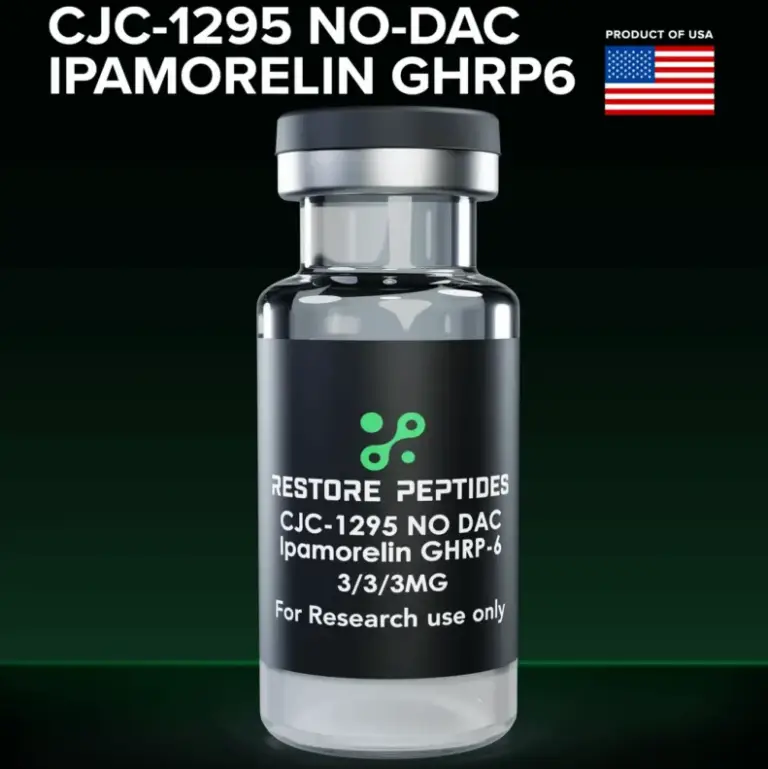
The CJC-1295 / Ipamorelin / GHRP-6 blend combines three synthetic peptides frequently examined in preclinical laboratory research involving peptide classification, receptor interaction, molecular signaling, and analytical characterization.
What Is the CJC-1295 / Ipamorelin / GHRP-6 Blend?
The CJC-1295 Blend is a lyophilized laboratory preparation containing three individually synthesized research peptides:
- CJC-1295
- Ipamorelin
- GHRP-6
These compounds are generally categorized within growth hormone secretagogue research. In an RUO setting, the combination may be used to examine peptide identity, receptor-binding characteristics, molecular interactions, analytical purity, and formulation consistency under controlled laboratory conditions.
CJC-1295
CJC-1295 is a synthetic peptide analog derived from growth hormone-releasing hormone-related peptide sequences. Preclinical investigations have examined its structure, receptor affinity, molecular stability, and behavior within animal models and isolated laboratory systems.
Discussions of CJC-1295 on an RUO website should remain limited to its chemical classification, research history, analytical properties, and use as a laboratory reference material.
Ipamorelin
Ipamorelin is a synthetic pentapeptide classified within the growth hormone secretagogue research category. It has been examined in preclinical models for its molecular structure, receptor selectivity, binding characteristics, and signaling profile.
The compound is supplied strictly as a laboratory research material. Its presence in a blended formulation allows researchers to compare and characterize multiple peptide structures within a single controlled preparation.
GHRP-6
GHRP-6 is a synthetic hexapeptide and one of the earlier compounds developed within the growth hormone secretagogue research class. Animal and laboratory studies have examined its receptor-binding behavior, molecular signaling characteristics, and interaction with related peptide pathways.
Within an RUO narrative, GHRP-6 should be discussed only in relation to preclinical investigation, molecular classification, analytical testing, and controlled laboratory study.
Why Researchers Examine a Three-Peptide Blend
Blended peptide preparations allow laboratory researchers to evaluate more than one synthetic peptide within a standardized formulation. CJC-1295, Ipamorelin, and GHRP-6 possess different peptide sequences and research classifications, making the blend relevant to controlled investigations involving:
- Peptide identity and characterization
- Receptor-binding comparisons
- Molecular signaling research
- Formulation consistency
- Chromatographic purity analysis
- Lyophilized material stability
- Preclinical animal-model observations
Research findings involving individual components should not automatically be attributed to the blended formulation. Each study may use different materials, concentrations, models, controls, and experimental conditions.
Lyophilized Laboratory Material
This blend is supplied as a lyophilized research preparation. Lyophilization is a controlled freeze-drying process used to remove water from a material while preserving it in a dry form for laboratory storage and later analytical handling.
Product appearance may vary between batches due to differences in fill volume, excipients, vial geometry, freeze-drying conditions, and other manufacturing variables. Visual appearance alone does not establish peptide identity, purity, concentration, or suitability for a particular experiment.
Analytical Testing and Documentation
Properly documented research materials allow laboratories to review analytical data before beginning an experiment. Depending on the product and batch, documentation may include:
- High-performance liquid chromatography data
- Certificate of Analysis
- Batch or lot identification
- Purity reporting
- Material labeling
- Storage and handling information
HPLC purity data describe chromatographic composition under the conditions of the test. HPLC alone does not establish sterility, endotoxin status, biological activity, safety, or fitness for human or veterinary use.
Research Material Sourcing
Laboratories seeking to Buy Research Peptides should review product labeling, batch documentation, analytical data, storage requirements, and applicable institutional policies before acquiring any research material.
Restore Peptides supplies lyophilized peptide materials strictly for laboratory research. Product descriptions are provided for material identification and educational research context only.
Preclinical Research Context
Published preclinical literature has examined CJC-1295-related analogs, Ipamorelin, GHRP-6, and related peptide compounds using animal models, isolated tissues, receptor assays, and other controlled laboratory systems.
These studies are useful for understanding how researchers classify and investigate synthetic peptides. Results from preclinical models do not establish safety, effectiveness, approved use, or suitability outside a controlled research environment.
Preclinical Animal Research References
- Jetté L, Léger R, Thibaudeau K, et al. Human growth hormone-releasing factor albumin bioconjugates and the identification of CJC-1295 as a long-acting GHRH analog. Preclinical receptor and animal-model research.
- Alba M, Fintini D, Sagazio A, et al. Once-daily administration of CJC-1295, a long-acting GHRH analog, in the GHRH-knockout mouse. Preclinical mouse-model research.
- Raun K, Hansen BS, Johansen NL, et al. Ipamorelin, the first selective growth hormone secretagogue. Preclinical research involving animal and laboratory models.
- Walker RF, et al. Evaluation of GHRP-6 and GHRH-related signaling in a rat research model. Preclinical animal research.
Research Use Restrictions
This product is sold exclusively for laboratory research and analytical use. It is not a food, supplement, cosmetic, drug, biologic, medical device, or veterinary product.
- Not for human use
- Not for veterinary use
- Not for consumption
- Not for household use
- Not for clinical application
- Not for compounding
- Not intended to diagnose, treat, cure, mitigate, or prevent disease
Purchasers are responsible for ensuring that all acquisition, storage, handling, documentation, and disposal practices comply with applicable laws, institutional policies, and laboratory safety procedures.