
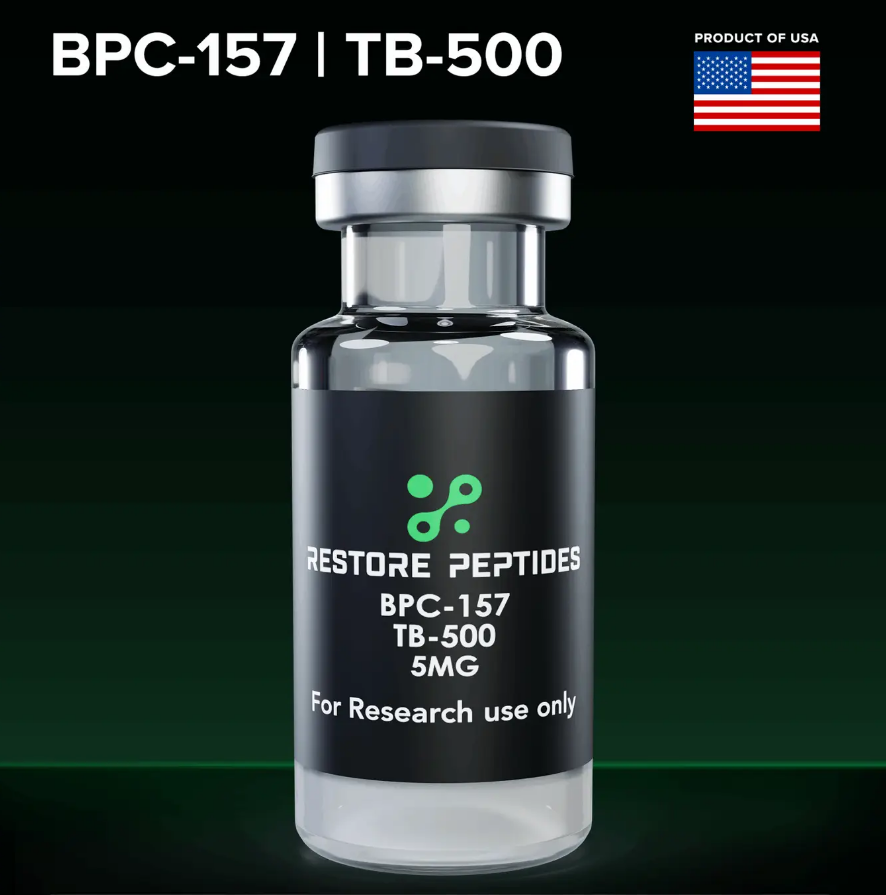
FOR RESEARCH USE ONLY. The content provided in this article is for educational and informational purposes only and is based on published scientific literature. The compounds and delivery formats discussed are not approved by the FDA for human or veterinary use. They are strictly intended for laboratory research and in vitro experimentation. Restore Peptides does not endorse or encourage the use of these products outside of a controlled research setting.
BPC-157 and TB-500 are among the most frequently referenced synthetic peptides in preclinical literature, and researchers sourcing high-purity peptide compounds for laboratory investigation encounter both regularly. Each has been studied independently across different experimental models: BPC-157 primarily in gastrointestinal and musculoskeletal contexts, TB-500 in cardiovascular and dermal ones. They share overlapping molecular targets that have prompted increasing interest in combined investigation.
Despite the volume of published preclinical data on each peptide individually, controlled studies examining both compounds together remain sparse. The existing literature describes proposed mechanisms that could theoretically interact, including angiogenic signaling, cytoskeletal reorganization, and nitric oxide modulation. Direct experimental evidence for synergistic effects is limited to a small number of animal model studies.
This article reviews published mechanistic data for BPC-157 and TB-500 separately, examines where their proposed signaling pathways converge, and outlines the evidence gaps that define this area of preclinical investigation.
Key Takeaways
- BPC-157 is a synthetic pentadecapeptide studied for its interactions with VEGFR2 signaling, nitric oxide modulation, and growth hormone receptor pathways in preclinical models since 1993.
- TB-500 is a 17-amino-acid synthetic fragment of thymosin beta-4, investigated primarily for its role in G-actin sequestration and cytoskeletal dynamics affecting cell migration in laboratory models.
- Both peptides have been independently associated with angiogenic signaling in published in vitro studies, representing a proposed point of mechanistic overlap.
- A 2025 systematic review of BPC-157 literature identified 35 preclinical studies and only one clinical study, reflecting the absence of controlled human data.
- No completed human efficacy trials for TB-500 have been published, and the FDA classifies both compounds as Category 2 bulk drug substances.
BPC-157 – Proposed Cytoprotective and Angiogenic Mechanisms
BPC-157 (sequence: Gly-Glu-Pro-Pro-Pro-Gly-Lys-Pro-Ala-Asp-Asp-Ala-Gly-Leu-Val; molecular weight 1,419.53 Da) is a synthetic pentadecapeptide derived from a partial sequence of a protein identified in human gastric juice. Sikiric et al. first characterized it in 1993. The majority of published research originates from this group at the University of Zagreb (1).
VEGFR2-Akt-eNOS Signaling
BPC-157’s best-characterized molecular interaction involves the vascular endothelial growth factor receptor 2 (VEGFR2) cascade. Hsieh et al. (2017) demonstrated that BPC-157 promoted VEGFR2 activation and internalization in human umbilical vein endothelial cells (HUVECs), with downstream phosphorylation of Akt and endothelial nitric oxide synthase (eNOS) (2). A follow-up study by the same group (2020) identified an additional mechanism: disruption of the Caveolin-1–eNOS inhibitory complex through the Src-Cav-1-eNOS pathway in isolated aortic ring preparations (3).
Both studies were conducted using research peptides for laboratory use in vitro. Neither has been replicated in human subjects.
Nitric Oxide System Modulation
Research from the Sikiric group has described a bidirectional relationship between BPC-157 and nitric oxide (NO) production. In experimental models of NO deficiency (L-NAME-induced NOS blockade), BPC-157 was associated with increased NO bioavailability. In models of excessive NO production (L-arginine overdose), BPC-157 was associated with reduced pathological overproduction (4). The molecular mechanism behind this proposed modulatory effect has not been fully defined, and independent confirmation from other laboratories is limited.
Growth Hormone Receptor Pathway
Chang et al. (2014) used cDNA microarray analysis on rat Achilles tendon fibroblasts and identified growth hormone receptor (GHR) as one of the most significantly upregulated genes following BPC-157 exposure. BPC-157 pretreatment also enhanced JAK2 phosphorylation when exogenous growth hormone was introduced (5). These findings come from a single in vitro fibroblast model. Researchers should confirm peptide purity and third-party testing documentation before replicating these assays.
TB-500 – Actin Dynamics and Cell Migration Research
TB-500 is a synthetic 17-amino-acid peptide corresponding to the active region (residues 17–23, sequence Ac-LKKTETQ) of thymosin beta-4 (Tβ4), a 43-amino-acid protein involved in actin cytoskeletal regulation. TB-500 and full-length Tβ4 are distinct molecules with different pharmacokinetic profiles. Research findings on one do not automatically transfer to the other (6).
G-Actin Sequestration
TB-500’s core proposed mechanism involves high-affinity binding to monomeric globular actin (G-actin), preventing its polymerization into filamentous actin (F-actin). Structure-function mapping identified the LKKTETQ motif as the functional core of Tβ4’s actin-binding activity (7). When cells receive migration signals, this sequestered actin pool becomes available for rapid cytoskeletal reorganization and lamellipodia formation, a process central to directed cell movement in experimental wound models.
Malinda, Goldstein, and Kleinman (1997) demonstrated that Tβ4 stimulated directed migration of HUVECs via this actin-based mechanism (8). Philp et al. (2003) extended these findings in diabetic and aged mouse dermal models, showing accelerated closure rates with both full-length Tβ4 and synthetic fragments containing the actin-binding domain (9).
Integrin-Linked Kinase and Cardiac Models
Bock-Marquette et al. (2004) published in Nature that full-length Tβ4 activates integrin-linked kinase (ILK), promoting downstream survival signaling in murine cardiac models following experimentally induced ischemic events (10). Smart et al. (2007), also in Nature, demonstrated that Tβ4 mobilized epicardial progenitor cells and promoted neovascularization in cardiac tissue (11). Researchers conducting cardiac model investigations with TB-500 fragments should source U.S.-manufactured peptides with documented batch traceability.
Hinkel et al. (2015) identified a critical distinction: the C-terminal AGES domain of full-length Tβ4, not the actin-binding region that TB-500 covers, may be the primary driver of post-ischemic benefit observed in cardiac models (12). This finding raises questions about how far TB-500 fragment-specific studies can be extrapolated from full-length Tβ4 research.
Proposed Mechanistic Overlap Between BPC-157 and TB-500
The published literature identifies two primary areas where BPC-157 and TB-500 share proposed molecular targets:
Angiogenic signaling. Both peptides have been independently associated with VEGF-related pathway activation in endothelial cell models. BPC-157 acts through VEGFR2-Akt-eNOS phosphorylation (2). Tβ4/TB-500 acts through endothelial cell migration and tube formation driven by actin-dependent motility (8), (9). Whether these mechanisms produce additive or redundant effects when both compounds are present in the same experimental system has not been established through controlled comparison studies.
Cytoskeletal reorganization. BPC-157 has been linked to FAK-paxillin phosphorylation in fibroblast and skeletal muscle cell migration models, while TB-500’s primary mechanism involves direct regulation of the actin monomer pool. Both pathways converge on the cellular machinery governing adhesion and directional movement, though through biochemically distinct entry points.
These overlapping targets are the published basis for investigating both peptides within the same experimental framework. Published studies specifically examining BPC-157 and TB-500 together in controlled preclinical designs remain limited, and no standardized co-administration protocols exist in the peer-reviewed literature.
Published Evidence and Research Limitations
The evidence base for both peptides is constrained by recurring gaps identified across published reviews.
BPC-157. A 2025 systematic review by Vasireddi et al. in HSS Journal screened 544 articles and retained 36 studies meeting inclusion criteria. Of these, 35 were preclinical animal models and one was a clinical study involving 12 patients (13). The review noted that the majority of published BPC-157 research originates from a single research group, and independent reproducibility remains a concern. The FDA classifies BPC-157 as a Category 2 bulk drug substance with identified safety concerns for compounding use.
TB-500. A 2025 review in Arthroscopy by DeFoor and Dekker confirmed that no human randomized controlled trial data for TB-500 in musculoskeletal indications exists (14). The strongest clinical signal for the parent molecule Tβ4 comes from Phase 2 and 3 ophthalmic trials by Sosne et al. (2015, 2022), which examined topical full-length Tβ4 in corneal models, a context separate from systemic fragment administration (15), (16). TB-500 is classified as a WADA-prohibited substance and an FDA Category 2 bulk drug substance. Certificate of analysis verification remains an essential quality control step for researchers working with either compound.
No published study has established a safety or efficacy profile for the combination of BPC-157 and TB-500 in any species.
BPC-157 and TB-500 Research – Preclinical Status and Open Questions
BPC-157 and TB-500 each carry their own mechanistic profile, built through decades of in vitro and animal model investigation. The published literature describes proposed convergence points in angiogenic signaling and cytoskeletal regulation that provide a mechanistic basis for studying both compounds within the same experimental design.
The central limitation is the same one that defines each peptide individually: a near-total absence of controlled human data. For BPC-157 and TB-500 research to move beyond preclinical characterization, independent replication of existing findings and controlled clinical trials are both needed. Researchers working with these compounds should verify peptide identity and purity through certificates of analysis and HPLC documentation, and should design experiments with the understanding that all existing mechanistic data derives from preclinical models with significant translational limitations.
FOR RESEARCH USE ONLY. The content provided in this article is for educational and informational purposes only and is based on published scientific literature. The compounds and delivery formats discussed are not approved by the FDA for human or veterinary use. They are strictly intended for laboratory research and in vitro experimentation. Restore Peptides does not endorse or encourage the use of these products outside of a controlled research setting.
Frequently Asked Questions
1. What is BPC-157?
BPC-157 is a synthetic pentadecapeptide (15 amino acids) derived from a partial sequence of a protein identified in human gastric juice. Sikiric et al. first characterized it in 1993. It has since been studied in over 100 preclinical investigations across gastrointestinal, musculoskeletal, vascular, and neural experimental models. BPC-157 is not approved by the FDA for any human indication.
2. What is TB-500 and how does it relate to thymosin beta-4?
TB-500 is a synthetic 17-amino-acid peptide fragment corresponding to the active actin-binding region (residues 17–23) of thymosin beta-4 (Tβ4), a naturally occurring 43-amino-acid protein. While TB-500 and full-length Tβ4 share the LKKTETQ motif responsible for actin sequestration, they are distinct molecules with different pharmacokinetic profiles and should not be conflated in research contexts.
3. Have BPC-157 and TB-500 been studied together in preclinical research?
Published preclinical studies examining both compounds simultaneously in controlled experimental designs remain very limited. The existing rationale for investigating them together is based on proposed mechanistic overlap in angiogenic signaling and cytoskeletal regulation, as identified through separate in vitro and animal model studies. No standardized dual-administration protocols have been established in peer-reviewed literature.
4. What are the primary research limitations for these peptides?
Both peptides lack controlled human clinical trial data. A 2025 systematic review of BPC-157 found only one clinical study among 36 retained publications. No human efficacy trials for TB-500 have been published. Both are classified as FDA Category 2 bulk drug substances and are prohibited by WADA. The majority of BPC-157 research originates from a single laboratory group, and independent replication remains limited.
5. What purity standards should researchers verify when sourcing these peptides?
Researchers should confirm peptide identity and purity through third-party certificates of analysis (COAs) that include HPLC purity data (≥98% is a standard benchmark for research-grade peptides), mass spectrometry confirmation of molecular weight, and documentation of U.S.-based manufacturing and batch traceability. These quality verification steps are standard practice in preclinical peptide research.
References
- Sikiric, P., et al. (1993). “A new gastric juice peptide, BPC. An overview of the stomach-stress-organoprotection hypothesis and beneficial effects of BPC.” Journal of Physiology (Paris), 87(5), 313–327.
- Hsieh, M.J., et al. (2017). “Therapeutic potential of pro-angiogenic BPC157 is associated with VEGFR2 activation and up-regulation.” Journal of Molecular Medicine, 95, 1235–1246.
- Hsieh, M.J., et al. (2020). “Modulatory effects of BPC 157 on vasomotor tone and the activation of Src-Caveolin-1-endothelial nitric oxide synthase pathway.” Scientific Reports, 10, 17592.
- Sikiric, P., et al. (2016). “Brain-gut Axis and Pentadecapeptide BPC 157: Theoretical and Practical Implications.” Current Neuropharmacology, 14(8), 857–865.
- Chang, C.H., et al. (2011). “The promoting effect of pentadecapeptide BPC 157 on tendon healing involves tendon outgrowth, cell survival, and cell migration.” Journal of Applied Physiology, 110(3), 774–780.
- Goldstein, A.L., et al. (2012). “Thymosin β4: A multi-functional regenerative peptide.” Expert Opinion on Biological Therapy, 12(Suppl 1), S37–S51.
- Crockford, D., et al. (2010). “Thymosin β4: Structure, function, and biological properties supporting current and future clinical applications.” Annals of the New York Academy of Sciences, 1194, 179–189.
- Malinda, K.M., Goldstein, A.L., & Kleinman, H.K. (1997). “Thymosin beta 4 stimulates directional migration of human umbilical vein endothelial cells.” FASEB Journal, 11(7), 474–481.
- Philp, D., et al. (2003). “Thymosin beta 4 promotes angiogenesis, wound healing, and hair follicle development.” Mechanisms of Ageing and Development, 125(2), 113–115.
- Bock-Marquette, I., et al. (2004). “Thymosin β4 activates integrin-linked kinase and promotes cardiac cell migration, survival, and cardiac repair.” Nature, 432, 466–472.
- Smart, N., et al. (2007). “Thymosin β4 induces adult epicardial progenitor mobilization and neovascularization.” Nature, 445, 177–182.
- Hinkel, R., et al. (2015). “C-terminal variable AGES domain of Thymosin β4: The molecule’s primary contribution to its coronary vasodilative and cardioprotective effects.” Journal of Molecular and Cellular Cardiology, 87, 113–125.
- Vasireddi, N., et al. (2025). “Emerging Use of BPC-157 in Orthopaedic Sports Medicine: A Systematic Review.” HSS Journal, 21(4).
- DeFoor, M.T. & Dekker, T.J. (2025). “Injectable Therapeutic Peptides-An Adjunct to Regenerative Medicine and Sports Performance?” Arthroscopy.
- Sosne, G., et al. (2015). “Thymosin beta 4 ophthalmic solution for dry eye: a randomized, placebo-controlled, Phase II clinical trial.” Cornea, 34(9), 1048–1054.
- Sosne, G., et al. (2022). “0.1% RGN-259 (Thymosin β4) Ophthalmic Solution Promotes Healing and Improves Comfort in Neurotrophic Keratopathy Patients in a Randomized, Placebo-Controlled, Double-Masked Phase III Clinical Trial.” International Journal of Molecular Sciences, 23(24), 16105.