
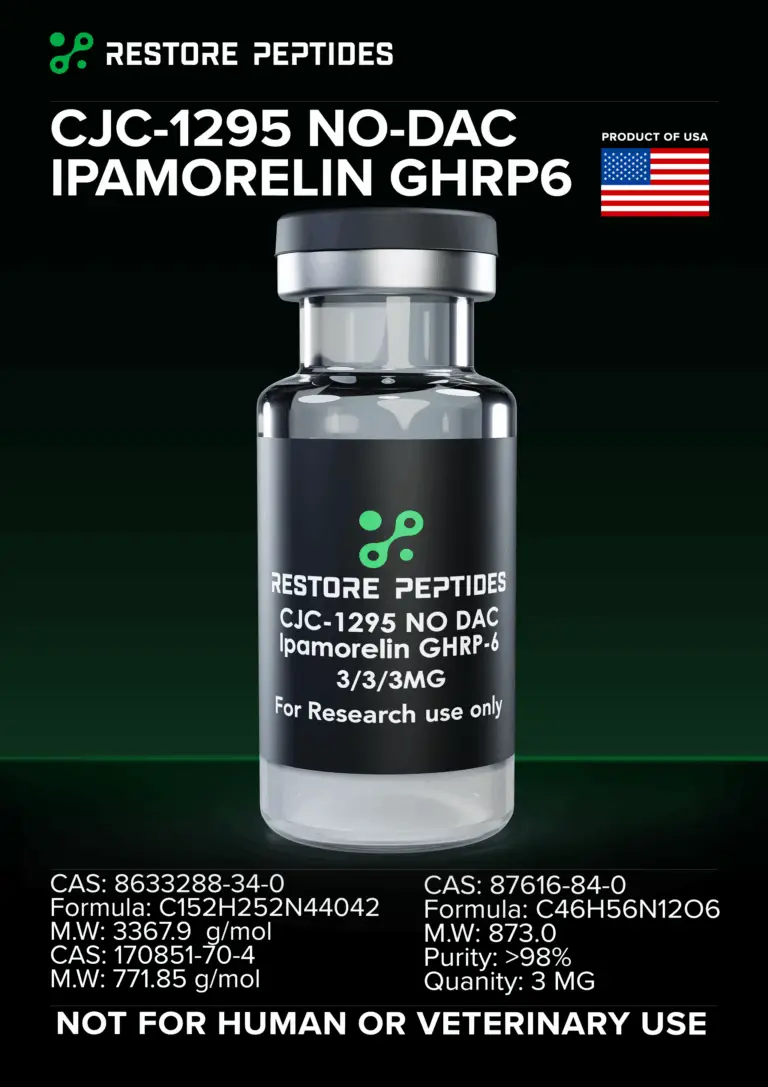
Growth hormone (GH) research continues to be an active area of scientific interest, particularly in studies exploring metabolism, body composition, tissue repair signaling pathways, and endocrine regulation. Among the most commonly studied growth hormone–releasing hormone (GHRH) analogs are CJC-1295 with DAC and CJC-1295 without DAC (also known as Modified GRF 1-29).
While both compounds are structurally related and operate through similar receptor pathways, they behave very differently in research models. Understanding these differences is essential for laboratories evaluating dosing frequency, pharmacokinetics, and growth hormone pulsatility.
This article provides a detailed breakdown of CJC-1295 DAC vs. No DAC, including mechanism of action, half-life differences, research implications, and practical considerations.
What Is CJC-1295?
CJC-1295 is a synthetic analog of Growth Hormone Releasing Hormone (GHRH).
In controlled laboratory settings, this compound is examined for its interaction with GHRH receptor pathways located in anterior pituitary tissue.
Rather than introducing external hormone sources, GHRH analogs are utilized in research to explore upstream signaling mechanisms within the endocrine cascade and how receptor engagement may influence downstream biochemical activity under controlled conditions.
Two primary forms are commonly evaluated:
- CJC-1295 with DAC (Drug Affinity Complex)
- CJC-1295 without DAC (Modified GRF 1-29)
The key distinction between these variants lies in structural modification, which has been observed in research settings to alter circulation time, receptor interaction dynamics, and overall signal duration.
CJC-1295 with DAC
What Does DAC Mean?
DAC stands for Drug Affinity Complex, a structural modification designed to promote reversible binding to circulating proteins such as serum albumin. In research settings, this interaction has been observed to extend the persistence of the compound within the system, altering how long it remains available for receptor interaction.
Activity Duration
In experimental models, the DAC-modified variant demonstrates a prolonged presence in circulation compared to non-modified forms. This extended duration is attributed to its protein-binding characteristics, which slow degradation and clearance.
Mechanism of Interaction
Laboratory studies have characterized the compound as interacting with GHRH receptor pathways in anterior pituitary tissue. Due to its extended presence, this interaction occurs over a longer timeframe relative to shorter-acting analogs.
Rather than producing brief, time-limited signaling events, the DAC-modified form is associated in research settings with more sustained pathway engagement.
Research Implications
Because of its extended activity profile, this variant is frequently utilized in studies examining:
- Prolonged receptor engagement under continuous exposure conditions
- Differences between sustained and transient signaling environments
- Peptide stability and degradation kinetics in circulation
- Temporal dynamics of endocrine pathway activation over extended periods
Observed Characteristics in Research Models
- Extended circulation time due to protein-binding interaction
- Sustained receptor pathway engagement compared to shorter-acting analogs
- Reduced temporal variability in signaling patterns under controlled conditions
Considerations in Experimental Design
- Extended persistence may not reflect naturally occurring pulsatile signaling patterns observed in endogenous systems
- Longer activity windows can limit the ability to observe rapid changes in pathway response
- Accumulation effects may influence interpretation of time-dependent signaling data
In controlled research environments, the DAC-modified form is often selected when the objective is to evaluate long-duration pathway interaction and stability, rather than short-interval signaling behavior.
CJC-1295 Without DAC (Modified GRF 1-29)
What Is Modified GRF 1-29?
CJC-1295 without DAC is a shorter-acting GHRH analog commonly referred to as Modified GRF 1-29. It contains targeted amino acid substitutions designed to improve stability in experimental conditions compared to native GHRH, while lacking the albumin-binding component found in DAC-modified variants.
Activity Profile
In laboratory models, this variant is characterized by a rapid onset and short duration of activity. Due to the absence of protein-binding modifications, it is cleared more quickly from circulation relative to DAC-modified forms. This shorter activity window makes it useful for evaluating time-dependent receptor interactions and transient signaling events.
Mechanism of Interaction
Experimental data suggests that Modified GRF 1-29 interacts with GHRH receptor pathways in anterior pituitary tissue. Because of its rapid clearance, this interaction occurs over a limited timeframe, allowing researchers to observe discrete signaling events rather than prolonged pathway engagement. This profile is often used to examine how short-duration receptor activation influences downstream biochemical responses in controlled environments.
Research Applications
Due to its kinetic profile, this variant is frequently utilized in studies focused on time-resolved receptor interaction dynamics, short-duration signaling pathways, comparative analysis of transient versus sustained pathway activation, and experimental models requiring precise temporal control of exposure conditions.
Observed Characteristics in Research Models
In controlled research environments, this compound has been associated with rapid clearance relative to DAC-modified analogs and a short-duration receptor interaction window. These characteristics allow for greater temporal separation between signaling events and minimal accumulation during extended observation periods.
Considerations in Experimental Design
Short activity windows may require tightly controlled timing in experimental setups, and transient signaling patterns may differ from those observed in sustained exposure models. Increased handling frequency may be necessary depending on study design, and data interpretation can depend heavily on timing precision and sampling intervals.
CJC-1295 DAC vs. No DAC — Key Differences (Research Context)
While both variants interact with the same receptor pathways, their behavior in experimental models differs significantly due to structural modification. The DAC-modified form demonstrates extended persistence in circulation, leading to longer periods of receptor engagement and a more continuous signaling environment. In contrast, the non-DAC variant is characterized by rapid clearance, resulting in shorter, time-defined interaction windows.
From a research design perspective, this creates two distinct modeling approaches. One involves extended exposure conditions where prolonged pathway interaction is the focus, while the other emphasizes time-resolved models in which discrete and controlled signaling events are evaluated. The DAC version aligns more closely with studies examining long-duration pathway engagement and stability, whereas the non-DAC version is better suited for precise temporal analysis of receptor activity.
Research Context: Sustained vs. Transient Signaling Models
In endocrine-related research, signaling pathways may be evaluated under either extended exposure conditions or short-duration activation models. Each approach offers different insights into receptor behavior, pathway modulation, and downstream biochemical responses. Short-acting analogs are often utilized in studies examining time-dependent signaling and pathway responsiveness, while extended-duration compounds may be used to evaluate longer-term pathway engagement and stability. Selection between these models depends entirely on the specific objectives of the experimental design.
Combination Studies in Research
In some experimental frameworks, GHRH analogs are evaluated alongside other compounds that interact with complementary receptor systems. These combination approaches are used to study multi-pathway signaling interactions and how different receptor mechanisms may influence overall pathway behavior. Due to differences in activity duration, shorter-acting and longer-acting analogs may be selected for different types of combination models, depending on whether the research focus is on transient signaling or extended exposure conditions.
Research Use and Compliance Considerations
CJC-1295 (with and without DAC) is intended strictly for research use only (RUO). These compounds are not approved for human or veterinary use and are not intended for diagnosis, treatment, or therapeutic application. They must be handled in accordance with laboratory research standards.
Quality considerations in research sourcing include verified purity through analytical testing such as HPLC, batch-to-batch consistency, controlled lyophilization processes, and proper storage and handling protocols to maintain stability and integrity.